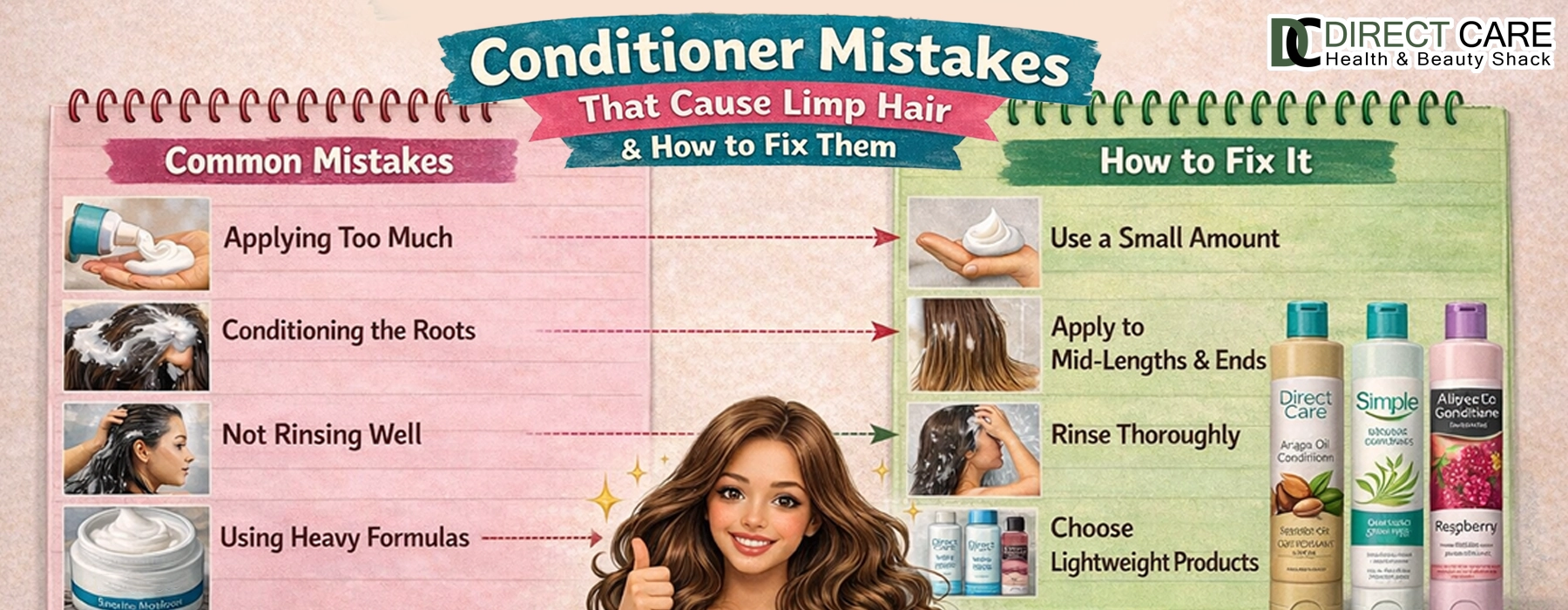
Fresh hair needs to feel light and full of movement. If the hair looks flat within an hour of drying, the conditioning routine likely requires a technical adjustment. Limp hair is rarely the fault of the hair itself. It is a result of mechanical errors during the washing process. You spend time on a professional look, only for the hair to collapse against the scalp. At Direct Care, we identify the specific conditioning habits adding unnecessary weight to your strands. Fixing these mistakes restores the structural lift and ensures your hair stays vibrant all day. Using the correct methods results in a noticeable change in hair density and bounce.
Applying conditioner to the scalp and roots
-
The scalp naturally produces a lubricant called sebum to protect the skin and the roots of the hair. Applying conditioner to this area creates a massive oil surplus that the hair fibres are incapable of supporting. This extra weight pulls the hair down at the base and eliminates any possibility of natural lift. A clean scalp provides the necessary foundation for volume. A conditioned scalp leads to a flat, greasy appearance.
-
Conditioning agents create a smooth film on the hair surface to increase shine. When this film exists near the scalp, it causes individual strands to stick together. These small clumps possess more mass than single hairs. They succumb to gravity instantly. This mechanical failure prevents the hair from standing away from the head. It results in a silhouette lacking the body and movement expected from a fresh wash.
-
The hair near the scalp remains “new” and retains its internal hydration. This makes extra conditioner unnecessary and harmful to volume. Roots require the natural lift provided by clean, unburdened strands to maintain their verticality throughout the day. Applying the product here only serves to flatten the hair. It interferes with the natural texture and bounce.
-
Heavy conditioners block the follicles and cause the hair to sit flat against the skin. This prevents air from circulating the roots. Without air circulation, the hair lacks the “breathability” required for a voluminous look. This mistake often forces people to wash their hair more frequently than necessary. It leads to a cycle of over-washing and limpness.
-
Product build-up at the root level is difficult to remove without harsh detergents. If you consistently apply conditioner to the scalp, the residue accumulates over time. This permanent weight makes the hair look dull and flat. It prevents the hair from holding any style or lift. Even a blow-dry is incapable of fixing the slump caused by root-level build-up.
Target the mid-lengths and ends
-
Professional hair care requires a specific zonal approach to manage moisture levels. You need to start the application at ear level and work the product through to the tips. This method targets the older parts of the hair requiring external moisture. These areas possess the most damage and need the smoothing benefits of the product. By focusing on the ends, you keep the healthy roots light and airy.
-
Applying product to the ends protects the most vulnerable parts of the hair. The tips are the oldest part of the hair fibre and require the most protection against breakage. Using conditioner in this zone allows the cuticle to close properly. It provides a smooth finish without weighing down the crown. This technique preserves the natural structural strength of the hair near the scalp.
-
A zonal application ensures the roots remain free of surface coatings. This allows the natural lift of the hair to remain intact. The hair stands up away from the scalp, creating a fuller appearance. You notice an immediate difference in the bounce of your hair. The strands feel lighter and move more freely. This provides a salon-quality finish at home.
-
Using conditioner on the mid-lengths prevents tangles and knots. It makes the hair easier to comb through after washing. This reduces the mechanical stress on the hair fibres. You avoid pulling and breaking the strands during styling. The hair maintains its integrity and density. It looks thicker and more vibrant as a result of this careful application.
-
This method ensures that the product is capable of doing its job where it is needed most. The ends of the hair are often the most porous. They absorb the conditioner and stay hydrated. The roots remain clean and retain their natural volume. You achieve a balanced look with smooth ends and lifted roots. This is the foundation of a high-performance hair care routine.
Using an excessive volume of conditioner
-
Every hair strand possesses a finite capacity for external hydration and surface coating. Once the hair fibre reaches its saturation point, any additional conditioner stays on the exterior as a heavy coating. This coating adds physical mass, but the strand remains incapable of holding up. You must respect the saturation limits of your hair to keep it from slumping. Excess product dries into a microscopic film, attracting environmental pollutants.
-
A heavy surface film blocks natural light reflection. This makes the hair look matte and dirty rather than vibrant. You achieve a better lustre by using a precise amount of conditioner that the hair cuticle is capable of absorbing. Overloading the hair results in a dull finish. It makes the hair look like it needs washing again within hours. This waste of product also increases the difficulty of the rinsing stage.
-
Large amounts of conditioner cause the strands to clump together. These clumps are far heavier than individual hairs. They pull the style down and eliminate natural movement. The hair looks like one solid mass instead of individual, flowing strands. This clumping is a clear sign that you used too much product. It ruins the effort put into washing and styling.
-
Excessive product attracts dust and microscopic particles from the air. These stick to the residual film on the hair. This further increases the weight on each hair strand. It leads to a heavy finish that persists even after thorough drying. Small amounts of product provide better results than a heavy application. You protect the hair from environmental damage by using the correct dosage.
-
Overloading the hair makes the drying process much slower. The extra product traps water in the hair fibres. You spend more time using heat tools to dry the hair. This increased heat exposure is capable of damaging the hair over time. Using less product allows the hair to dry faster. It maintains its natural health and volume without the need for excessive heat.
Use a precise, coin-sized amount
-
Product volume needs to match the length and density of the hair fibres. For fine hair, a pea-sized amount provides enough moisture for the mid-lengths and ends. Thicker hair requires a slightly larger volume, such as a 20-pence piece. Using more product does not lead to softer hair. It only leads to flatter hair. You identify an overload by the physical feel of the hair during application.
-
High-integrity conditioners work efficiently in small doses. You need to find the exact balance your hair density requires for a lightweight finish. Reducing the amount of product ensures the hair fibres remain unburdened. The hair feels hydrated but not coated. This allows for maximum lift and bounce. You achieve a professional result with a fraction of the product.
-
Using a wide-tooth comb helps spread a small amount of conditioner evenly through the lengths. This ensures every strand receives a thin, equal coating. This technique prevents product pockets where a large amount of conditioner accumulates in one spot. This specific section of the hair goes limp and ruins the overall shape of the style. You maintain the structural integrity of the style by ensuring an even distribution.
-
A precise amount of conditioner is easier to rinse away. You spend less time under the water. This reduces the mechanical stress on the hair. The hair remains clean and free of residue. It stands away from the scalp with ease. You notice the hair feels significantly lighter. It holds its style for a much longer period.
-
This approach is more cost-effective and better for the hair. You avoid wasting high-quality products like those from Wella or Provoke. A single bottle lasts much longer when you use the correct amount. You get the full benefits of the professional formula without the negative side effects of overuse. Your hair stays healthy and voluminous with every wash.
Failing to rinse the product out thoroughly
-
Incomplete rinsing remains the primary cause of product build-up and flat hair. Any conditioning agent remaining on the hair after the shower acts as a permanent physical weight. This residue prevents the hair from holding a style. It makes the hair look greasy by midday. You need to spend at least two minutes rinsing to ensure the hair remains truly clean. Even a tiny amount of leftover product is capable of attracting enough dirt to weigh down fine strands.
-
Residual conditioner coats the hair and prevents it from drying properly. It creates a sticky texture that is unpleasant to touch. This stickiness is a magnet for environmental pollutants. The hair feels heavy and weighed down. It lacks the “slip” and smoothness of truly clean hair. This failure to rinse leads to immediate post-shower limpness.
-
If the hair still feels soft or slick under the water, the product remains on the surface. This surface film blocks the lift of the hair. It prevents the strands from moving independently. The hair looks clumped and lifeless. You need to be thorough in the rinsing stage to avoid this outcome. Rinsing is just as important as the application itself.
-
Leaving product in the hair can lead to scalp irritation. If the conditioner is not rinsed away, it can cause itching or flaking. This affects the overall health of the scalp. A healthy scalp is necessary for voluminous hair. Residual product interferes with this balance. It creates a poor environment for hair growth and lift.
-
Residual conditioning agents make styling much more difficult. Heat tools like straighteners or curling irons react poorly with product build-up. The hair can become “singed” or feel crunchy. This ruins the texture and the look of the style. Thorough rinsing ensures the hair is a clean canvas for any styling tools. It results in a much more professional finish.
Use the cool-water squeak test
-
You identify clean hair by the sound it makes under the water. When the hair remains free from excess conditioner, it loses that slimy, slippery feel. It starts to feel “squeaky” between the fingers. This sound confirms that the surface residue has disappeared. The hair remains ready to maintain its natural volume. If the hair still feels soft or slick, keep rinsing until you achieve this result.
-
A cool water rinse for the final thirty seconds changes the physical state of the hair. Cool water hardens the hair cuticle and locks in the internal moisture. This temperature shift also makes it easier to remove the external oils, causing limpness. The resulting surface remains smooth, clean, and light. It is a simple step that significantly improves the light-reflecting properties of the hair strands.
-
Achieving this “squeak” is the most reliable way to ensure you remove the surface film. It signals that only the necessary conditioning agents remain inside the hair cortex. The hair feels lighter and easier to manage. You notice an immediate improvement in the hair’s bounce. It stands up away from the scalp and moves with more freedom. This is the sign of a successful wash.
-
Closing the cuticle with cool water remains a mechanical requirement for bouncy hair. Warm water expands the hair shaft, making it more flexible but also more prone to absorbing excess weight. The cool rinse acts as a reset button. It contracts the fibres and ensures the hair is as light as possible. You begin the drying process with hair that is ready to hold volume.
-
A final cool rinse increases the shine and lustre of the hair. It provides a professional, salon-like finish. The hair looks healthy and vibrant. It feels smooth to the touch without any greasy residue. This simple technique is one of the most effective ways to fix limp hair. It ensures your conditioning routine supports your hair goals.
Choosing heavy, intensive formulas for fine hair
-
Using intensive repair formulas on fine hair fibres remains a technical error. These products contain large molecules and heavy silicones designed for coarse or highly porous hair. On a fine strand, these heavy molecules cause an immediate and permanent slump. You need to match the molecular weight of the product to the density of the hair. Fine hair requires lightweight, water-based hydration.
-
Heavy formulas coat the exterior of the hair in a thick film. This film is too heavy for a fine strand to support. The hair simply lacks the strength to stay upright. It collapses against the scalp and looks greasy. This mistake is common among those trying to fix damaged hair. They choose the most “intensive” product available without considering its weight.
-
Dense conditioners often contain heavy oils and butters like shea or cocoa. These ingredients are excellent for coarse hair but disastrous for fine hair. They do not penetrate the fine hair shaft and instead sit on the surface. This adds unnecessary physical mass. The hair looks flat and lifeless as a result. You must choose a product that suits your specific hair density.
-
Formula mismatch leads to “moisture overload.” The hair becomes too soft and loses its natural elasticity. It cannot hold a curl or any form of volume. It feels “mushy” when wet and limp when dry. This is a sign that the conditioning agents are too heavy for the hair type. You need to adjust the formula to restore the hair’s body.
-
Using the wrong product makes the hair harder to style. It requires more styling products to try to create volume. This only adds more weight to the hair. It creates a cycle of limpness that is difficult to break. Selecting the correct formula from the start is the most effective way to avoid this problem. It ensures the hair remains light and manageable.
Select lightweight and volumising formulas
-
Professional-tier options like the Wella System Professional AG Colour Save Conditioner provide protection without the weight. This formula focuses on cuticle health and colour vibrancy using smaller molecules. These do not coat the exterior in a heavy film. They provide the correct choice for those needing moisture without the mass. These lightweight formulas are capable of penetrating the hair shaft to provide strength from within.
-
Specialised conditioners like the Provoke Highlight Boost Conditioner restore strength to bleached strands. These fix the damage from highlights without causing the hair to sit flat. Choosing the correct specialised formula remains a deterministic way to keep textures right. These boosters provide the necessary luminosity without the grease. They are engineered to provide maximum results for fine or treated hair.
-
Look for ingredients that provide volume from within. Lightweight proteins and water-based hydrators strengthen the hair without adding a greasy exterior. You must avoid heavy waxes for daily use on fine or medium hair. Ingredients such as “hydrolysed silk” or “wheat protein” add structural integrity to the hair strand. They help the hair to “remember” its shape, providing a subtle hold that keeps the hair looking full.
-
Choose products specifically labelled for volumising or fine hair. These formulas undergo testing to ensure they do not leave a heavy residue. At Direct Care, we supply conditioners engineered for these specific requirements. We understand the chemistry of the hair strand. Fine hair needs support, not suppression. Selecting a lightweight formula ensures your hair retains its natural movement.
-
A lightweight formula provides a “dry” finish that feels clean to the touch. It looks incredibly healthy and vibrant. The hair moves independently and holds its shape throughout the day. You achieve a professional finish by using the correct product for your hair density. This is a simple but effective fix for chronic limp hair issues. Your hair stays light and full of life.
Applying conditioner to dripping wet hair
-
Applying conditioner to dripping wet hair remains a waste of product. Water fills the gaps in the hair cuticle and acts as a physical barrier. The conditioner remains incapable of making contact with the fibre. It simply washes away or stays on the very surface. This leads to poor hydration and a greasy exterior. You need the conditioner to replace the water inside the hair, not sit on top of it.
-
When you apply product to a soaked strand, the active ingredients cannot find a place to bond. This results in a lack of softness and an increase in surface weight. The hair feels like it hasn’t been conditioned at all, yet it looks flat. This is because the product is sitting on the surface rather than penetrating the hair cortex. It is an inefficient way to manage your hair care routine.
-
Diluted product is far less effective. The concentration of the conditioning agents is lowered by the excess water. You do not get the full benefits of the professional formula. The hair remains prone to tangles and damage. This mistake often leads people to use more product to get a result. This only increases the risk of limp hair from overloading.
-
Waterlogged hair is more fragile. Applying product and working it through soaked hair can lead to breakage. The hair is at its most vulnerable when it is completely saturated with water. You need to remove the excess water to protect the integrity of the hair fibres. This ensures the hair stays thick and full.
-
This application error results in a lack of style retention. The hair lacks the internal strength provided by properly absorbed conditioner. It falls flat almost immediately after styling. You spend time on a look that does not last. Correcting this step is one of the easiest ways to improve your hair’s volume and health.
Use the towel-squeeze method for better absorption
-
Squeeze the excess water out of the hair before you apply the conditioner. Removing the water ensures the product makes direct contact with the hair strand. This leads to better absorption and significantly less surface residue. The hair remains light because the conditioner stays inside the fibre, not on top of it. This simple mechanical shift in your routine ensures every drop of product is working to improve your hair health.
-
When the hair remains damp, conditioning agents enter the hair cortex more effectively. Internal moisture supports the hair’s structure and provides strength. Surface moisture, in contrast, pulls the hair down. A drier application allows the product to grip the hair fibre and do its work efficiently. This deep penetration is what gives hair its “bounce.”
-
The towel-squeeze method means you need less product to achieve a better result. This prevents the overloading, causing limpness. It remains a more precise way to manage your hair care routine. You ensure you do not waste high-quality product. By increasing the efficacy of the conditioner, you also reduce the amount of time you need to spend rinsing later.
-
This technique results in a much more professional finish. The hair feels strong and healthy from within. It is more resistant to the weight of humidity and styling products. You achieve a level of body and lift that is usually only seen in a salon. It is a high-performance technique used by professionals to get the best out of any conditioning treatment.
-
Removing excess water before application protects the hair from breakage. It allows the conditioner to provide the necessary “slip” to detangle the hair safely. The hair stays thick and vibrant. You notice a significant improvement in the hair’s overall texture. This is a fundamental step in a successful hair care routine for voluminous hair.
TAKE COMMAND OF YOUR HAIR CARE ROUTINE
Transitioning away from limp, flat hair requires a shift in both your technique and your choice of tools. Our hair conditioner collection provides the professional-grade formulas needed to restore your hair’s natural volume. By avoiding scalp application and choosing lightweight formulas like Wella System Professional AG Colour Save, you protect the structural integrity of your hair. We offer a diverse range of conditioners designed to meet the specific requirements of fine, coloured, or damaged hair. Browse our full inventory today to find the specialised treatments that support your hair health. Experience the benefits of a high-performance routine that delivers lift and vibrancy with every wash.